The Five Best Aeroplan Sweet Spots

The best ways to use my favorite program and maximize the value of your points!
What Not To Do
The single biggest piece of advice with Aeroplan is simple: unless you absolutely have to, do not redeem Aeroplan points on Air Canada-operated flights.
As ironic as that sounds, you will almost always get significantly more value booking Air Canada’s Star Alliance partners instead. Air Canada uses dynamic pricing on its own flights, while partner awards follow fixed, distance-based charts. The result is that the same route often costs far more points on Air Canada metal than on a partner.
Beyond pricing, Air Canada’s premium cabins are, in my view, not competitive with many of its partners, particularly ANA, EVA, Turkish, Thai, and in some cases United. Aeroplan shines when you treat it as a partner-award program rather than an Air Canada loyalty scheme.
Earning Aeroplan Points
Aeroplan is easy to earn thanks to its wide range of transfer partners. Points can be transferred from most major credit card programs, including American Express and Chase, often with transfer bonuses in the 25 to 30 percent range. This makes it relatively easy to build a meaningful balance quickly when a good redemption appears.
How Aeroplan Calculates Award Pricing
At first glance, Aeroplan pricing can seem opaque. In reality, it is driven by just two variables: the total distance flown and the geographic regions involved.
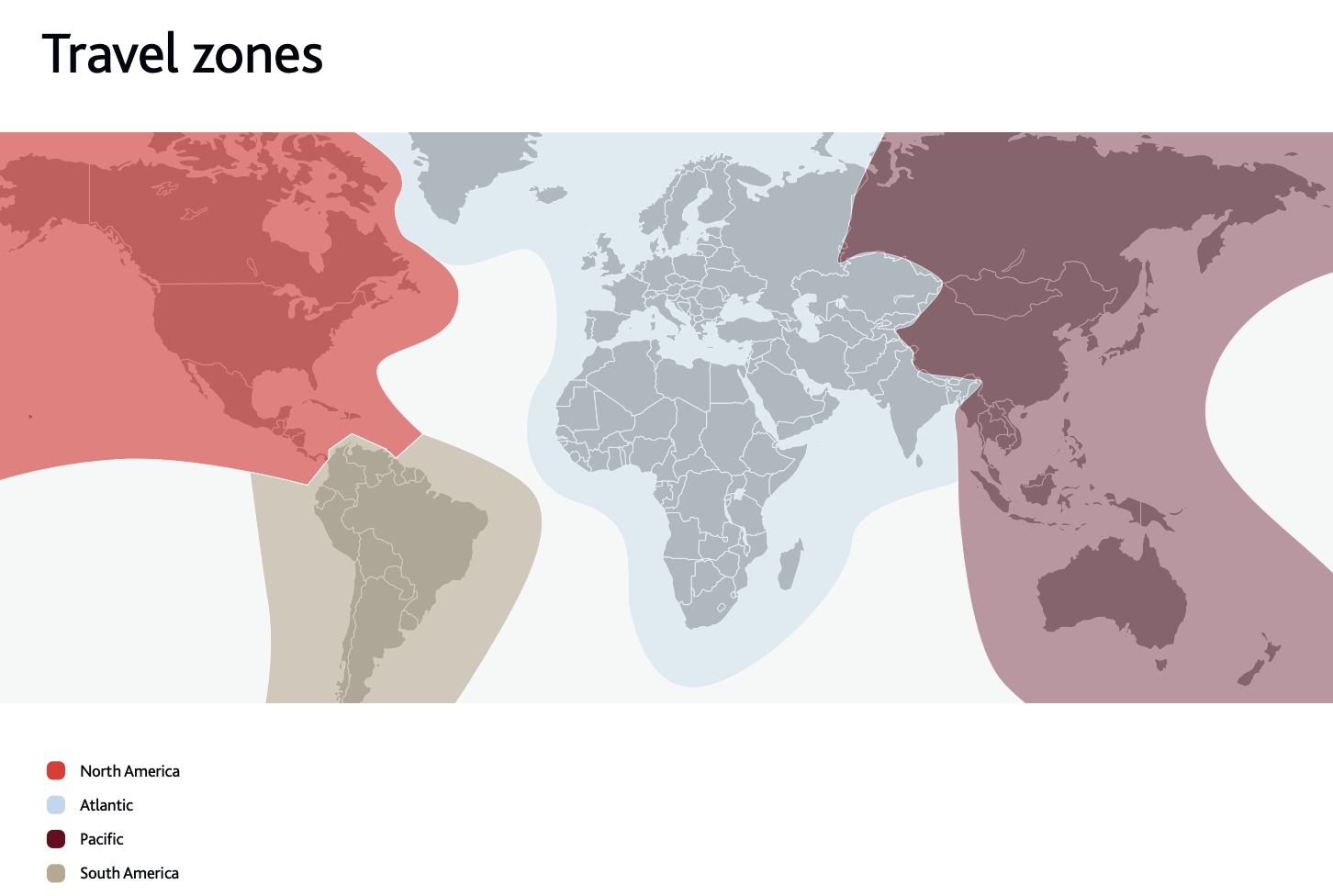
The Aeroplan Region Map
When booking partner airlines, Aeroplan uses a fixed distance-based award chart rather than dynamic pricing. Once you understand where the major distance breakpoints sit, it becomes surprisingly easy to predict award costs and identify outsized value when itineraries fall just under key thresholds.
1. Business Class Flights Between Asia and North America on Partner Airlines



One of Aeroplan’s most powerful sweet spots is travel between North America and the Pacific region when the total distance flown stays under 7,501 miles.
For itineraries below that threshold, business class prices at 75,000 Aeroplan points one-way, inclusive of connections. Tools like Seats.aero make it easy to calculate total routing distance, which is critical for staying within this band.
For example, a routing from Los Angeles to Beijing via Seoul prices at 75,000 points because the total distance is 6,543 miles. A seemingly similar itinerary from Los Angeles to Beijing via Taipei prices at 87,500 points because the total distance increases to 7,858 miles, pushing it into the next pricing tier. The difference has nothing to do with airline quality or routing preference, only total distance flown.
2. Business Class Flights Between North America and Europe on Partner Airlines


For flights between North America and Europe, the single most important number to remember is 4,000 miles.
Under Aeroplan’s Atlantic zone pricing, itineraries at or below 4,000 total miles fall into the lowest long-haul distance band. When booked on partner airlines, this band prices at 60,000 points one-way in business class, making it one of the strongest redemptions in the entire program.
A perfect example is Boston to Lisbon. The nonstop flight clocks in just under 4,000 miles and can be booked for 60,000 points in business class. That is exceptional value for a transatlantic lie-flat seat.
Once you cross the 4,000-mile threshold, pricing increases. Lisbon to Los Angeles illustrates this clearly. Despite being a nonstop flight on the same airline, the longer distance pushes the price to 70,000 points one-way. The increase is purely distance-based and has nothing to do with aircraft, service, or demand.
This is why East Coast gateways matter so much with Aeroplan. Flights from cities like Boston, New York, or Montreal to Western Europe often remain under 4,000 miles. From the West Coast, nearly all Europe-bound itineraries cross the threshold and cost more points.
3. First Class Intra-Asia Flights on Thai Airways



Thai Airways operates first class on select routes between Tokyo and Bangkok, including Narita, Haneda, and Osaka. These flights can be booked for 60,000 Aeroplan points one-way in first class, which is an extraordinary deal.
Thai’s first class product has been significantly refreshed and remains one of the most luxurious ways to fly in the region. For roughly six and a half hours of flight time between two major Asian cities, this redemption delivers a level of comfort that rivals far more expensive long-haul first class experiences.
4. Business Class Flights Between Asia and Europe


Flights between Asia and Europe can be overlooked by Aeroplan members based in North America, largely because they are rarely convenient for positioning. Ironically, that lack of convenience often results in better availability.
Routes such as Bangkok to Istanbul are frequently available in business class for around 60,000 points one-way on Thai Airways. Even longer itineraries between East Asia and deeper parts of Europe or the British Isles can often be booked for 80,000 points in business class, including ultra-long-haul flights like Tokyo to London that approach 15 hours in duration. On a value-per-point basis, these redemptions can be exceptional.
5. Economy Class Flights Within North America
While less glamorous, Aeroplan’s pricing for domestic and short-haul flights within North America is one of the program’s most consistently useful sweet spots.
For flights under 500 miles, partner awards start at 8,000 points one-way in economy, or 16,000 points round-trip, most commonly on United Airlines. These redemptions often outperform cash fares, particularly on high-frequency business routes or last-minute bookings.
Aeroplan also offers strong value on longer domestic flights. Transcontinental routes such as Newark to Los Angeles can be booked for 30,000 points one-way in United domestic first class, and occasionally Polaris, which is often far cheaper than paying cash or booking through United’s own program.
This may not be the flashiest use of points, but it is one of the most reliable. When cash fares spike, Aeroplan frequently provides a predictable and effective alternative that simply works.
